Wave Wire Services
LOS ANGELES — Dolores Huerta, who co-founded the United Farm Workers union with César Chávez and became one of the most recognizable voices in support of workers, women, civil rights and immigrants, died Oct. 28 at age 96.
“We are deeply saddened to announce that our beloved mother, Dolores Huerta, has passed away today at the age of 96,” her family posted on social media. “As you can imagine, this is an incredibly difficult time for us, and we ask for privacy as we grieve this incredible loss to our family.
“We know that many of you around the world share in our mourning, and we will be following up on plans to recognize and celebrate her incredible life and legacy.”
A spokesman for the family told the New York Times Huerta died of cancer.
Dolores Clara Fernández was born April 10, 1930 in Dawson, New Mexico, and moved to Stockton, California at age 3 with her mother after her parents divorced.
Witnessing racism against Latino-Americans from early on inspired her toward activism. The National Museum of Women’s History lists two significant events she witnessed as a child: when a prejudiced schoolteacher accused her of cheating because her papers were too well-written and in 1945 at the end of World War II, when white men brutally beat her brother for wearing a popular Latino fashion Zoot-Suit.
She took up her last name after marrying her second husband and fellow activist Ventura Huerta.
She received an associate teaching degree from the University of the Pacific’s Delta College and briefly taught school in the 1950s. Working with hungry farm children coming to school motivated her in organizing farmers and farm workers.
In 1955, she founded the Stockton chapter of the Community Service Organization, which led voter registration drives and fought for economic stability for Latinos.
Huerta met activist César Chávez through an associate and in 1962, the pair founded the National Farm Workers Association, the predecessor of the United Farm Workers’ Union. Huerta served as UFW vice president until 1999.
At the UFW, she negotiated contracts and ardently advocated for safer working conditions, including the elimination of harmful pesticides, and for unemployment and health care benefits for agricultural workers.
In 1973, Huerta led a consumer boycott of grapes resulting in the ground-breaking California Agricultural Labor Relations Act of 1975.
Throughout her career, Huerta worked to improve workers’ legislative representation and toward electing more Latinos and women.
In 2002, she created the Dolores Huerta Foundation, a civic advocacy organization designed “to cultivate empowered volunteer organizations actively pursuing social justice.”
Among the litany of honors she received during her lifetime, she was presented with the Presidential Medal of Freedom in 2012 by President Barack Obama, the highest civilian honor awarded in the United States.
In presenting the award, Obama said that when Chávez met with Huerta to discuss working together to form a farm workers union, “she thought he was joking.”
“She was a single mother of seven children, so she obviously didn’t have a lot of free time,” Obama said. “But Dolores had been an elementary schoolteacher and remembered seeing children come to school hungry and without shoes. So, in the end, she agreed, and workers everywhere are glad that she did.
“Without any negotiating experience, Dolores helped lead a worldwide grape boycott that forced growers to agree to some of the country’s first farm worker contracts. And ever since, she has fought to give more people a seat at the table.”
Obama issued a statement Oct. 28 calling Huerta “a hero of mine.”
“When she co-founded the National Farm Workers Association in 1962, people thought Dolores was crazy,” he said. “‘How are you going to organize farm workers?’ she remembered being asked. ‘They are poor, powerless immigrants.’ But that’s exactly what she did, helping thousands of migrant laborers working in brutal conditions make their voices heard, and demand something better.
“Dolores spent the rest of her life fighting for marginalized communities, even as she herself faced sexism and abuse — including, as she revealed earlier this year, from César Chávez and others within her own movement.”
Earlier this year, Huerta went public with her allegation that Chávez raped her in 1966 after driving her to a secluded grape field in Delano, California. She said she never reported the attack out of concerns for police hostility toward Chávez and the labor movement, and because she feared she wouldn’t be believed.
Huerta said in a statement she had two sexual encounters with Chávez — the first of which involved her being “manipulated and pressured into having sex with him” — and the other in which she “was forced against my will.”
“I had experienced abuse and sexual violence before, and I convinced myself these were incidents that I had to ensure alone and in secret,” Huerta said. “Both sexual encounters with César led to pregnancies. I chose to keep my pregnancies secret and, after the children were born, I arranged for them to be raised by other families that could give them stable lives.”
The allegations by Huerta and other women led to a posthumous fall from grace for Chávez, long considered a hero of the labor movement. His name has subsequently been stripped from buildings, roads, parks and other locations across the country.
Following news of her death, Gov. Gavin Newsom directed state flags to be lowered to half-staff.
“She never faltered in fighting for a fairer world, continually reminding us of our shared responsibility to build a world where everyone has the respect and dignity they deserve,” Newsom and wife Jennifer Siebel Newsom said in a joint statement. “Because of her — and her iconic declaration, ‘Sí, se puede’ — nothing was impossible.

“Dolores changed the course of history against all odds. Through protests and marches, including the Delano grape boycott, she fundamentally reshaped California as we know it. She was more than an inspiration — though she never stopped inspiring us — she was a dear friend.
“Her legacy lies not just in the accomplishments she achieved, but in the people who follow in her footsteps, who take up the mantle and keep creating a better world.”
Former President Joe Biden called Huerta a “giant of the American labor and civil rights movements.”
Los Angeles Mayor Karen Bass hailed Huerta for “securing basic human rights for some of the hardest working people among us.”
“Dolores carried the fight into every arena where people were denied a voice,” Bass said. “She championed women’s rights, reproductive freedom, and gender equality, and she organized communities, here in Los Angeles and across the nation, so that all people had a stronger voice in the decisions that shape their lives. Her legacy is one of dignity and equality for all, and proof of what ordinary people can accomplish when they organize.”
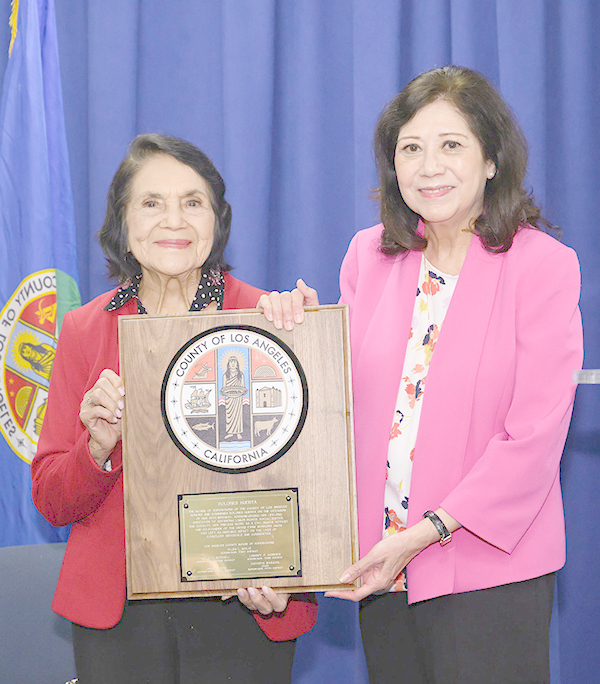
County Supervisor Hilda Solis said in a statement she was heartbroken by Huerta’s death.
“It is difficult to imagine my life in public service without her,” Solis said. “For decades, she was a source of strength, a trusted friend and a partner in some of the most important fights of my career. I learned so much from Dolores, and I will forever cherish the time we shared and the privilege of having worked alongside her.”
Solis, who chairs the Board of Supervisors, ordered county flags lowered to half-staff in honor of Huerta.
County Supervisor Janice Hahn called Huerta “an extraordinarily strong person.”
“As a young woman she had the courage to lead the movement for the rights of farmworkers,” Hahn wrote on X. “In her later years, she demonstrated even greater courage to tell the truth about the abuse she herself had suffered in that movement.
“When I was growing up, most of our major civil rights leaders were men. I remember how powerful it was to see Dolores Huerta be equally strong and equally impactful. She showed generations of women what leadership could look like.”
Los Angeles City Councilwoman Eunisses Hernandez said Huerta “was incredibly influential on my life.”
“She was tough as nails. A phenomenally brave woman who set the tempo for how to fight for our communities,” Hernandez wrote on X. “My heart is shattered. I’m sending so much love to her family. May she be resting in the warm embrace of our ancestors.”