By Stephen Oduntan
Contributing Writer
INGLEWOOD — One week after the city rescinded controversial 120-day exclusion notices issued to members of Bryan Bostic’s family and their supporters, relatives returned to City Hall June 23 to again press for answers about his death. By the end of the meeting, three speakers had been removed from the council chambers.
The meeting marked the family’s first appearance before the council since the city withdrew the exclusion notices. Emotional testimony and the strict enforcement of public comment rules underscored the continuing divide between city officials and those seeking answers about Bostic’s death.
Bryan Bostic, 37, died March 10 following an encounter with Inglewood police during a traffic stop. The Los Angeles County Medical Examiner ruled his death an accident caused by the effects of methamphetamine, but his family disputes that conclusion, citing video of his struggle with officers.
The family has since filed a wrongful death claim against the city and police department. Since his death, relatives and supporters have attended nearly every City Council meeting seeking the identities of the officers involved, additional records and greater transparency surrounding the circumstances of his death.
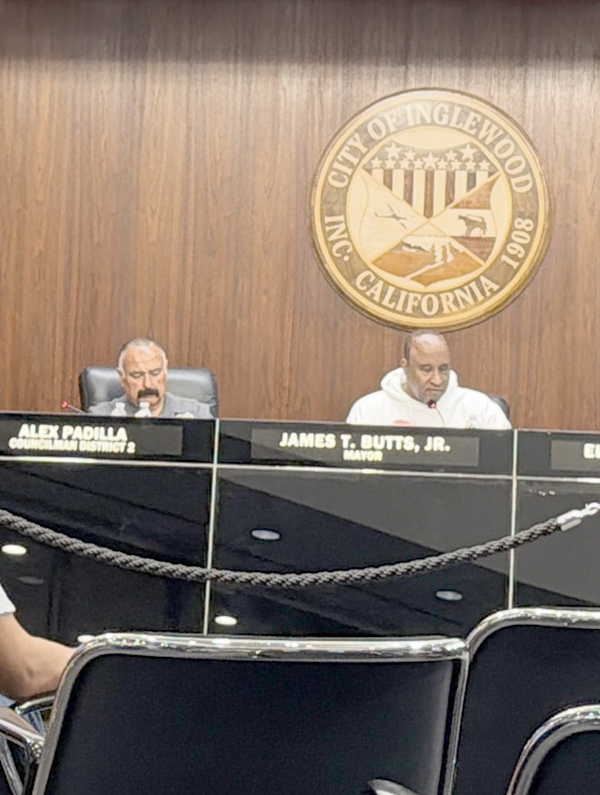
Before public comment began June 23, Mayor James T. Butts Jr. reminded those in attendance that the City Council was obligated to conduct the public’s business in an orderly manner and warned that the city’s rules of decorum would be strictly enforced.
“No matter what, the council and the city have the greatest sympathy for the family of Bryan Bostic,” Butts said. “We do have to conduct the public’s business.”
The Wave requested comment from Butts Jr.’s office and the city clerk’s office regarding the meeting, the rescission of the exclusion notices, the removal of three speakers, and the city’s handling of the Bryan Bostic case. Neither office responded prior to press time.
Butts reread the council’s rules of decorum, warning that anyone who violated them would be required to leave the council chambers. Throughout the afternoon, he repeatedly glanced at the large digital countdown timer mounted on the chamber wall, closely monitoring each speaker’s allotted time as he enforced the city’s one-minute speaking limit.
Public comment quickly turned to Bostic’s death, with relatives, activists and community members using their allotted minute to challenge the city’s handling of the case.
The first to address the council was Bostic’s cousin, Shun, who greeted the mayor by saying, “Welcome back to our movement, Mr. Butts,” before invoking the words of the Rev. Martin Luther King Jr.
“Injustice anywhere is a threat to justice everywhere,” Shun said, arguing that the family would continue demanding accountability until those responsible for Bostic’s death were identified.
Bostic’s aunt, Marie Darden, followed by criticizing Butts’ previous public reading of the Los Angeles County Medical Examiner’s findings, arguing that the family believes the official account is contradicted by video evidence.
“Mayor Butts, you were so elated reading that Medical Examiner’s report,” Darden said before again calling for the release of the officers’ identities and additional records related to her nephew’s death.
As public comment continued, speaker after speaker echoed the family’s demands for transparency and accountability.
Grassroots Black Lives Matter organizer Sheila Bates accused city leaders of placing greater importance on maintaining order than addressing the family’s unanswered questions.
“You disrupted a life,” Bates said. “So, yeah, we’re going to disrupt a meeting until we get justice in the name of Bryan Bostic.”
Bostic family member Charise Walker continued the family’s call for transparency, while community members Rick Ford and Jessica Ford questioned the city’s commitment to justice and accountability.
As Jessica Ford’s allotted minute expired, Butts ended her remarks.
“I had a lot more to say,” Ford said before returning to her seat.
Moments later, community activist Baba Akili approached the podium and opened not with his own words, but again with those of King.
“Some of us are more obsessed with order than we are with justice,” Akili said, quoting King’s “Letter from Birmingham Jail.”
Akili said the Bostic family had returned to City Hall meeting after meeting seeking “simple answers to simple questions,” but had instead been met with “disrespect, denial and degradation.”

He then invoked Malcolm X before criticizing the city’s handling of the case and referencing his own removal from the previous week’s council meeting.
“I’ve been put out of better places than this before,” Akili said.
As the countdown timer expired, Butts instructed Akili to conclude his remarks. Akili continued speaking.
“Please remove him,” Butts directed.
As security officers approached, Akili replied, “I can find my way out myself,” before walking toward the exit.
Akili became the first of three people removed from the meeting. Later, Bates and Walker were also escorted from the council chambers after continuing to address the council beyond their allotted speaking time despite repeated warnings from Butts.
Outside City Hall after the meeting, Bates said rescinding the exclusion notices had done little to restore the family’s confidence in city leaders.
“They rescinded it, but they still threatened they could do it again,” Bates said. “For them to sit there and say they have compassion for the family while continuing to treat them this way is absolutely despicable.”
Bostic’s aunt, Marie Darden, said she believes the city withdrew the exclusion notices only after realizing they could not withstand legal scrutiny.
“They knew that was illegal from the jump,” Darden said. “They tried to silence us, bully us and intimidate us. They knew they were wrong, so they had to rescind it.”
Stephen Oduntan is a freelance writer for Wave Newspapers.