By Darlene Donloe
Contributing Writer
LOS ANGELES — In a white-walled compound a few blocks from Skid Row, a third grader is learning fractions by building a clay city, a high school sophomore is scoring a short film she directed, and a math teacher from South Los Angeles is figuring out how to turn a poetry lesson into a lesson on data.
Since 1989, Inner-City Arts has been making the case that creativity isn’t an elective — it’s infrastructure.
The nonprofit’s 720 Kohler Street campus has become an engine for public education in Los Angeles, serving more than 200,000 students and 10,000 teachers since it opened. It touts itself as an organization that helps unlock the creative potential of underserved Los Angeles children and teens.
Ask Collette Williams Alleyne, the organization’s chief education officer, to describe the place, and she doesn’t start with programs.
“Inner-City Arts is where creativity and belonging come together,” Alleyne said. “It’s a place where young people are invited to take risks, to solve problems, to collaborate and express themselves in ways that aren’t always possible in a traditional classroom.”
Originally from New Orleans, Alleyne knows that from experience. She’s been dancing since she was 2. She attended the New Orleans Center for Creative Arts from third grade through 12th grade.
“It was part of my school day,” she said. “Since third grade, I didn’t take (physical education). Dance was my physical activity. It’s a sport and an art.”
She moved to Los Angeles to teach, but said she wanted to work at Inner-City Arts “because it brought together all of the things I feel are part of my purpose.”
As the chief education officer, Alleyne supports the students, the teaching artists and the educators.
“I mostly design the systems that ensure that every student experiences a high-quality arts learning,” she said. “I work on partnerships. I work on supporting the teaching artist through professional development. I work on looking at how our systems function in the arts education system. I know the value of arts education because I had the arts in my life, all of my life.”
That value shows up in the data and in the classroom. Every year, more than 5,000 Los Angeles Unified School District elementary students are bused to the campus for arts instruction during the school day, part of a long-running district partnership.
The students’ classroom teachers are linked to Inner-City Arts for instruction in the visual and performing arts during their school day.
Once weekly, for up to 17 weeks per term, students and teachers work with professional teaching artists, focusing on a specific art form.
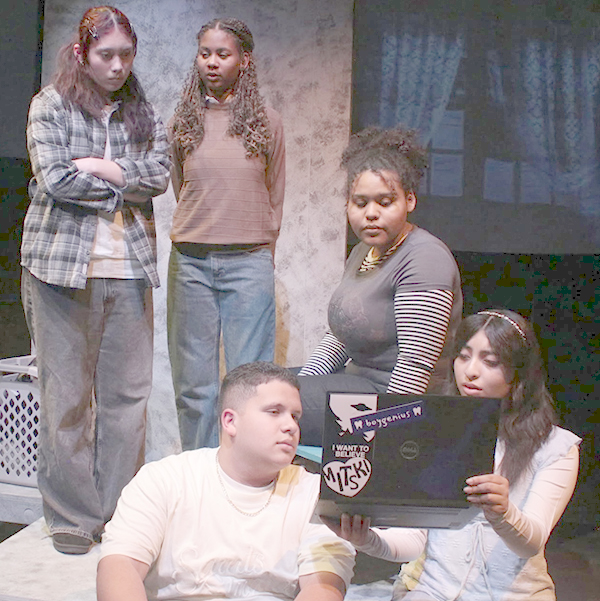
Each year, 1,000 more middle and high school students pick their discipline — ceramics, dance, animation, theater, music — in after-school, weekend and summer studios.
The Professional Development Institute trains educators to weave creative practices into reading, English and math.
Independent evaluations find children who attend Inner-City Arts score “dramatically better” in math, language arts and creativity.
But Alleyne points to something less measurable.
“They leave with more than artwork,” said Alleyne, a married mother of three. “They leave with a greater confidence in themselves, a greater understanding of themselves, and just what they can do. And I know it sounds big, but what they can do in their community and in the world.”
The best part, Alleyne said, is when students surprise themselves.
“We’ve had scenarios where students may be non-verbal, or they are not expressive in the school setting,” she said. “They will share about their process. This could be a student who hasn’t talked the entire school semester, and they’re speaking about their artwork. Or students are performing for the first time on stage, or working through a challenge in our creativity lab where they can’t figure out how to connect a piece, and they figure it out. It’s the challenge of getting past what appeared to be a barrier.”
Alleyne believes participants would lose a lot if Inner-City Arts didn’t exist.
“I think the kids would lose more than art,” she said. “They would lose the ability to learn who they are. They would lose a place that helps kids imagine.”
The campus itself makes the point. The Rosenthal Theater, a state-of-the-art performance space, hosts student productions and community events, putting professional tools in the hands of teenagers who might otherwise never see a light board or a recording console.
The facilities are intentional — sunlit studios in an industrial neighborhood — built on the premise that access to beauty and rigor shouldn’t depend on a ZIP code.
That premise gets loud July 25, when Inner-City Arts holds its second annual Battle of the Bands from 5 to 9 p.m. Teen rock bands from across Los Angeles take the Rosenthal stage before guest judges, competing on musicianship, stage presence, and originality.
The top prize is a professional recording session in the campus music studio and a Guitar Center gift card.
The work continues Aug. 3-4, when Inner-City Arts convenes its Arts Educator Expo.
Teachers, teaching artists, school leaders, and community partners will gather for two days of workshops and collaboration aimed at strengthening arts education citywide. An opening reception runs 10 a.m. to 1 p.m. on Aug. 3, with expo workshops on Aug. 4, all at 720 Kohler St.
“When people ask about the value of arts and the role Inner-City Arts plays in it, I would say the value is invaluable,” Alleyne said. “Sometimes it takes a moment to see the impact the arts have on a kid, and sometimes you see it immediately. It’s essential we stay a part of the educational journey for the whole child and having a well-rounded education.”
Inner-City Arts also offers two summer programs at its downtown Los Angeles campus for students in grades K-12. The program includes the two-week, full-day SPLASH camp for younger students and specialized art classes for older students. The K-5 summer camp was held from June 15 to June 26. The middle and high school programs (grades 6-12) ran from July 6 to July 17. Students selected specialized classes, which include photography, rock band, and improv.
Alleyne is proud of the services Inner-City Arts provides to the community.
“I’m proud that as an organization, we stayed committed to the arts, stayed for our community, and we acted responsibly in the service we provide,” she said. “We want our community to know we serve communities through the school day and that, as a professional, you can come here and be introduced to your creative voice.”
She believes that when it comes to the arts, the sky is the limit.
“I know what the arts did for me,” Alleyne said. “Anything and everything is possible because of my work as a dancer. I am who I am because of my experience as a dancer. If it worked for me, it can work for these kids.”
After 36 years, Inner-City Arts is less an intervention than an institution — one built on the belief that a paintbrush, a monologue, or a bass line can change how a child walks into a classroom.
“It’s the challenge of getting past what appeared to be a barrier,” Alleyne said.
Darlene Donloe is a freelance reporter for Wave Newspapers who covers South Los Angeles. She can be reached at ddonloe@gmail.com.